Cryptocurrency guides
Tron scan is a TRON explorer for accounts, TRX staking, and energy planning
Key takeaway: TRON blockchain explorer for searching accounts, transfers, contracts, and tokens, with a Rent Energy tool for fee-resource planning.
Tron scan is a TRON blockchain explorer for checking wallet activity, TRC20 transfers, smart contracts, token pages, Super Representative votes, and network resources from one searchable interface. It is best known as TRONSCAN, the first explorer built for the TRON network, and it gives users a public view of blocks, transactions, accounts, contracts, nodes, tokens, staking parameters, and Rent Energy workflows.
Search starts with an address, transaction hash, token, or contract
The fastest way to use the explorer is to paste the exact item you want to inspect. A TRON address reveals account balances, token holdings, transfers, frozen or staked TRX, voting activity, permissions, and resource usage. A transaction hash opens the status, timestamp, block, sender, recipient, contract interaction, bandwidth, energy, and fee details. Token pages organize TRX, USDT, USDD, SUNDOG, PePe, PROS, TBULL, and other assets that move through the network.
This matters because TRON activity is heavily address-driven. Stablecoin payments, exchange deposits, smart-contract calls, and wallet transfers all settle into public records. Tron scan turns those records into pages that normal users can read without running a node or parsing raw blockchain data.
TRC20 transfers and USDT activity are the everyday lookup case
TRON carries a large amount of TRC20 stablecoin traffic, especially USDT. When someone sends or receives a TRC20 token, the explorer shows whether the transfer succeeded, which contract processed it, how much was moved, and which addresses were involved. The transaction page separates a simple TRX transfer from a token transfer or a smart-contract execution, which helps users understand what actually happened on-chain.
Day to day, Tron scan also helps identify token clutter. Public wallets receive promotional tokens, dust, and scam-like airdrops because address histories are visible to automated senders. The presence of an unfamiliar token in an account does not prove value or endorsement. The useful habit is to inspect the token contract, holders, transfer pattern, and official project information before interacting with it.
Energy, bandwidth, and TRX fees shape transaction cost
Importantly, TRON uses resource accounting rather than a single gas market identical to Ethereum. Bandwidth covers basic transaction data, while energy is consumed by smart-contract execution. Accounts receive a limited amount of free bandwidth, and users obtain more resources by staking TRX or by paying TRX when resources are insufficient.
The Resource Calculator and Rent Energy area make Tron scan more than a passive viewer. They let users estimate the resource side of a transaction before sending it. This is especially useful for frequent TRC20 transfers, contract calls, or wallet operations where energy charges decide whether a transaction is cheap, expensive, or blocked by an insufficient balance.
Rent Energy is for planning contract-heavy wallet actions
Rent Energy addresses a practical TRON problem: a user needs enough energy for a transaction but does not want to lock TRX for resource generation. The tool presents energy rental as a fee-resource workflow, so a sender can plan contract interactions with clearer cost expectations. It fits actions such as moving TRC20 USDT, interacting with DeFi contracts, or preparing a wallet for several transfers.
Before using any rental flow, the important fields are the receiving address, resource quantity, duration, and final cost in TRX. A small mistake in an address still becomes an on-chain action, so address checking deserves the same attention as the payment amount.
Staking TRX connects balances to votes and network resources
TRX staking on TRON serves two visible purposes: resource generation and governance participation. When users stake or freeze TRX, they receive voting power for Super Representatives and gain access to bandwidth or energy resources. The explorer shows staking parameters, proposal activity, voting records, and Super Representative rankings, so the governance layer is not hidden inside a wallet interface.
In practice, Tron scan gives account owners a way to review whether their TRX is liquid, staked, delegated, or tied to voting choices. That distinction matters when preparing a transfer, changing permissions, or evaluating why a wallet has voting activity attached to it.
Contracts, verification, and broadcast tools support builders
Developers use the explorer to inspect deployed contracts, review internal transactions, verify contract code, and broadcast signed transactions. The site also surfaces developer tools around TronGrid, TronWeb, TronBox, TronIDE, Java-tron, GitHub resources, and API access. For teams building wallets, dashboards, token tools, or analytics, these components reduce the gap between raw chain data and application-ready information.
API access is especially relevant for products that query account histories, token transfers, or transaction status at scale. TRONSCAN announcements have also highlighted API key requirements, so application teams need to treat explorer API access as an authenticated infrastructure dependency rather than a casual unlimited endpoint.
Account pages reveal permissions, holdings, and wallet hygiene
A TRON account page brings several signals together. Balances show TRX and token holdings. Permission sections show owner and active authorities, including multisig structures. Transfer history shows who interacted with the account. Resource panels explain bandwidth and energy consumption. Token holdings show both familiar assets and unexpected airdrops.
When reviewing a wallet, scan these items in a steady order:
- Confirm the address matches the wallet or exchange record exactly.
- Check recent TRX, TRC10, and TRC20 transfers.
- Review contract interactions before approving related actions elsewhere.
- Inspect permissions if multisig or delegated access is involved.
- Compare resource usage with the transaction fees paid.
That sequence turns Tron scan into an audit surface for everyday wallet management, not just a place to see whether a transfer arrived.
Network dashboards show TRON beyond a single wallet
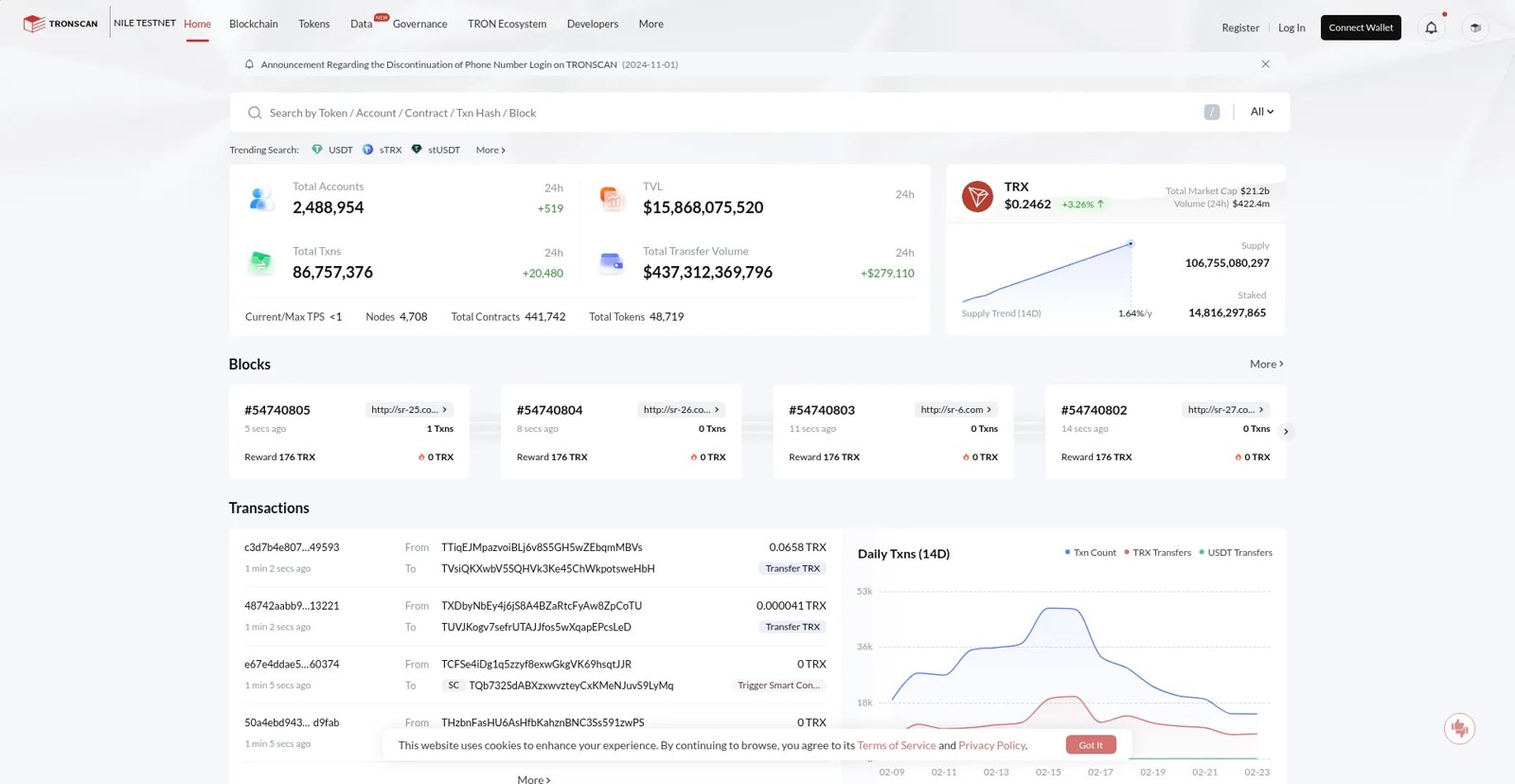
The home and analytics areas summarize the network through total accounts, total transactions, transfer volume, total value locked, active accounts, protocol revenue, nodes, blocks, charts, rankings, and resource consumption. These figures help users move from one transaction to the broader state of TRON activity.
Token Tracker and Hot Tokens pages add market-facing context by grouping assets, holders, transfers, and popularity signals. DeFi and ecosystem sections point toward JustLend DAO, SUN, SunPump, SunX, JustStable, USDD, stUSDT, BTTC, BTFS, TronLink, and other TRON-aligned infrastructure. The explorer is therefore useful for both transaction confirmation and discovery, provided the user separates public listing from personal due diligence.
Getting started without a wallet connection
Most lookups require no login. Paste an address, hash, block number, token name, or contract address into search and open the matching result. From there, filter by transfers, transactions, tokens, contracts, resources, or governance records. A connected wallet becomes relevant when voting, interacting with staking, signing, or using tools that require an account action.
Notably, Tron scan supports multiple login methods, yet read-only research works from the public pages. That separation is useful: a user can confirm an exchange withdrawal, inspect a token contract, or check a Super Representative page before connecting TronLink or another compatible TRON wallet.
Where this explorer fits beside wallets and analytics sites
A wallet such as TronLink is built for signing, storing, and sending. A data site such as DefiLlama is built for cross-protocol TVL and ecosystem comparison. Tron scan is strongest when the question is specific to TRON chain state: Did this transaction confirm? Which contract did this address call? How much energy was consumed? Which token contract created this transfer?
That focus makes it a first stop for troubleshooting deposits, reviewing TRC20 movement, checking staking status, monitoring contract pages, and understanding why a transaction cost TRX. It does not replace a wallet, exchange record, accounting export, or security review; it gives the public on-chain facts those tools rely on.
Tron scan - common questions
Does Tron scan require a wallet login to check a transaction?
No. Transaction lookup is public, so you can paste a TRON transaction hash into the search bar and read the status, block, timestamp, sender, recipient, token transfer, and resource usage without connecting a wallet. Login or wallet connection becomes relevant only when you perform account actions such as voting, staking, signing, or using interactive tools.
What does energy mean on a TRON transaction page?
Energy is the TRON resource consumed by smart-contract execution. TRC20 token transfers and DeFi interactions use energy because they call contracts. If an account has enough staked or rented energy, the action consumes that resource. If it does not, the transaction burns TRX to cover the required resource cost.
Can I use Tron scan to identify a fake TRC20 token?
It helps you investigate a token, but it does not make the final trust decision for you. Check the contract address, holder distribution, transfer history, token page details, and whether the project points to the same contract from its own channels. Random airdropped tokens and lookalike names appear on public chains, so contract identity matters more than the displayed symbol.
Which wallet works best with TRONSCAN account actions?
TronLink is the wallet most closely associated with TRON ecosystem actions, including signing, staking, voting, and contract interaction. Other TRON-compatible wallets support transfers and account management, but feature coverage varies. For read-only searches, no wallet is required; for signed actions, use a wallet that supports the specific TRON function you intend to perform.
How long does a TRON transfer take to appear in the explorer?
A normal TRON transfer appears after the transaction is broadcast and included in a block. The explorer then shows confirmation status, timestamp, block number, and transfer details. Delays usually come from the sending wallet, exchange batching, network submission issues, or an incorrect destination address rather than from the public explorer display itself.
Why do unknown tokens show up on my TRON address?
TRON addresses are public, and automated senders can distribute unsolicited tokens to visible wallets. These tokens may be promotional, worthless, or designed to lure users into unsafe swaps and approvals. Seeing one in an account does not mean the wallet was hacked. Treat unfamiliar assets as data entries until the contract and project identity are checked.
Fees on Tron scan look different from my wallet balance change. Why?
Wallets and explorer pages present cost from different angles. A transaction page shows resource consumption, TRX burned, contract execution, and token movement. Your wallet balance reflects the combined effect of sent value, received value, fees, and any resource coverage from staked or rented energy. Reviewing both the transfer tab and resource fields usually explains the difference.