Cryptocurrency guides
Tron scan wallet is a TRON account view for balances, transfers, TRC-20 tokens, and energy usage
Key takeaway: TRON blockchain explorer account view for checking wallet balances, transfers, contract activity, and TRC-20 token holdings.
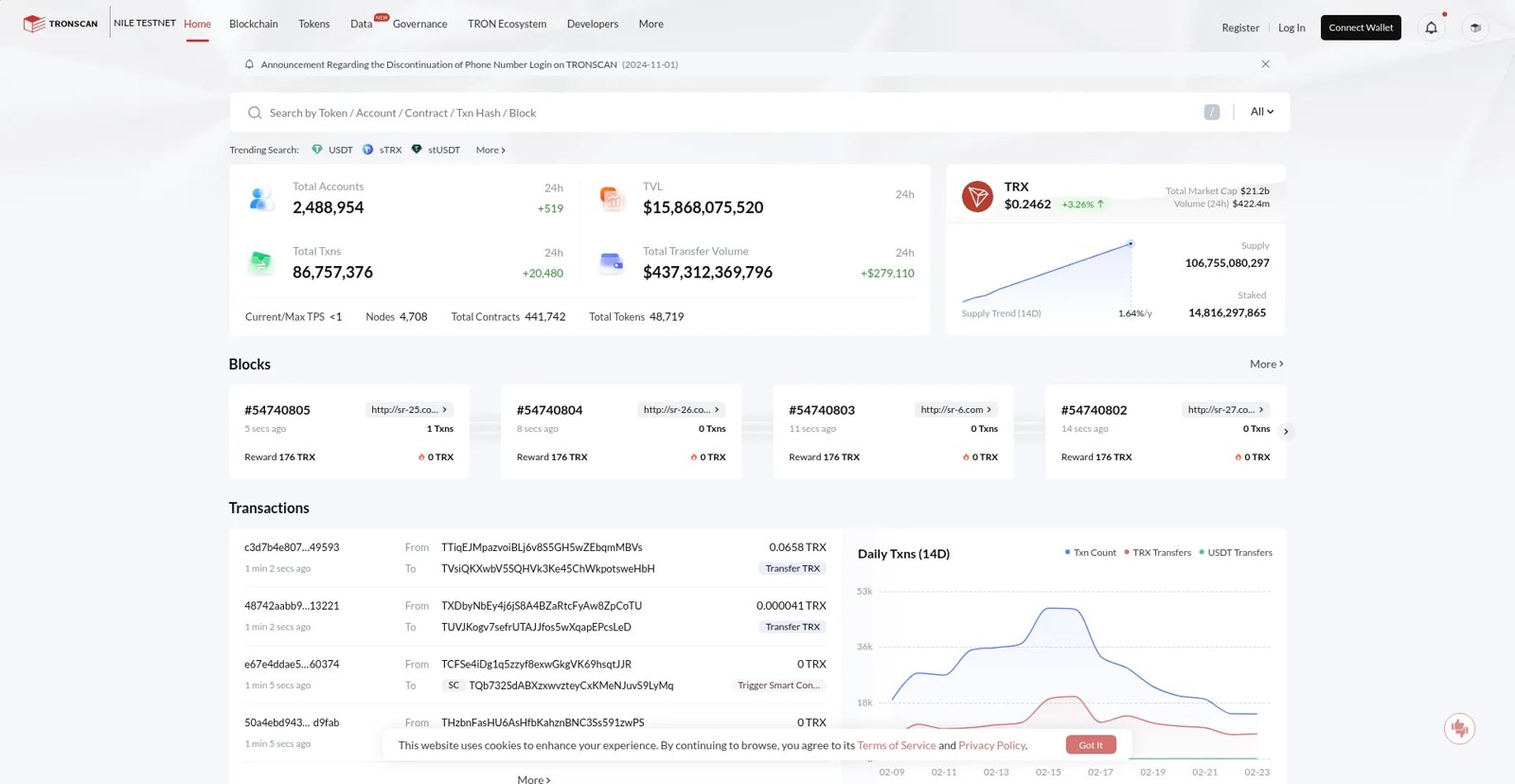
Tron scan wallet is a practical way to inspect a TRON address through TRONSCAN, the long-running blockchain explorer for the TRON network. It shows TRX, TRC-10 and TRC-20 token holdings, transfer history, contract calls, approvals, votes, staking activity, and resource consumption. The same account page also helps a user understand whether a USDT transfer will spend Energy, Bandwidth, or burned TRX.
The phrase describes a wallet-facing explorer workflow rather than a separate custody product. You paste or open a TRON address, connect a compatible wallet such as TronLink when interaction is needed, and read the public account record that the chain exposes. That matters because TRON is heavily used for stablecoin settlement, especially USDT on the TRC-20 standard, where small resource details decide the real cost of each transfer.
Reading a TRON account before moving funds
A TRON address starts with T and represents an account on the TRON network. On an explorer account page, the first checks are simple: confirm the address, view the TRX balance, scan the token list, then read the most recent transfers. A Tron scan wallet lookup gives the same kind of visibility that a bank statement gives for activity, except the data is public, irreversible, and tied to blockchain confirmations.
The account page becomes especially useful when a payment is expected. Incoming transfers show the token, amount, sending address, receiving address, timestamp, and transaction hash. If the payment is USDT, the token contract matters as much as the amount. TRC-20 USDT uses the contract address beginning TR7NHqjeKQxGTCi8q8ZY4pL8otSzgjLj6t, so matching the token record avoids confusing real USDT with an unrelated token carrying a similar name.
Where TRC-20 balances and transfer history appear
TRONSCAN separates native TRX activity from token activity because different actions touch different parts of the network. A native TRX transfer is straightforward. A TRC-20 transfer calls a smart contract, records token movement in the contract log, and consumes Energy as the contract executes. That distinction explains why a wallet balance and the transaction fee line do not always feel intuitive to a new user.
Inside Tron scan wallet results, token holdings are normally listed with the token name, ticker, contract, balance, and value information when available. Popular entries on TRON include TRX, USDT, USDD, SUN-related assets, and meme tokens such as SUNDOG. The strongest habit is to click through to the token contract from the account page before trusting a ticker, because token names repeat while contract addresses remain specific.
Energy, Bandwidth, and the cost of a USDT transfer
For context, TRON uses two resource concepts that matter at wallet level. Bandwidth covers basic transaction data. Energy covers smart contract execution, including TRC-20 token transfers. Accounts receive some free Bandwidth, and users gain more resources by staking TRX. When an account lacks enough Energy or Bandwidth, the network charges TRX by burning it to complete the transaction.
This is where the page title's energy rental angle fits. Energy rental lets a user obtain temporary Energy for contract-heavy actions, most visibly USDT transfers, without keeping a large amount of TRX staked only for occasional transactions. TRONSCAN's tool area includes resource-oriented utilities such as a Resource Calculator and Rent Energy entry, so the explorer doubles as a planning surface before a transfer is signed.
| Action | Main resource | What the wallet page helps confirm |
|---|---|---|
| Send TRX | Bandwidth | Sender, receiver, amount, fee, and confirmation status |
| Send TRC-20 USDT | Energy plus Bandwidth | Token contract, contract call, resource burn, and transaction hash |
| Vote for Super Representatives | Staked TRX voting power | Vote target, amount of votes, and governance history |
| Interact with DeFi | Energy | Contract address, method call, approvals, and execution result |
Connecting TronLink changes the page from viewer to action surface
Most explorer checks require no login because balances and transfers are public. A connected wallet changes the experience when an action must be signed. TronLink is the ecosystem wallet most closely associated with TRON, and TRONSCAN lists it among infrastructure tools. Once connected, a user can sign account actions such as transfers, votes, staking operations, or contract interactions from supported surfaces.
A Tron scan wallet session should keep a clear boundary between viewing and signing. Viewing an address exposes no private key. Signing a transaction authorizes a change on-chain. The safest rhythm is to inspect the destination address, token contract, resource cost, and approval request before the wallet prompt is accepted, because confirmed TRON transactions settle permanently.
Contract activity, approvals, and DeFi traces
The account view becomes more valuable after a wallet touches DeFi. JustLend DAO, SUN, SunSwap-style swaps, SunPump launches, USDD, stUSDT, BTTC bridges, and other ecosystem contracts all leave traces. The explorer displays contract addresses, transaction hashes, token movements, and execution status, which helps separate a normal swap or lending action from an unexpected approval or outgoing transfer.
Approvals deserve special attention on any smart contract chain. A TRC-20 approval grants a contract permission to move a token up to an allowed amount. When a wallet has interacted with unknown contracts, reviewing token approval history and recent contract calls helps identify permissions that no longer serve a purpose. Tron scan wallet data gives the evidence needed to decide which approvals belong to active use and which ones should be revoked through a compatible wallet or tool.
Using the explorer for staking, votes, and account resources
On a practical level, TRON governance uses Super Representatives, votes, and staking parameters rather than a simple passive balance model. TRONSCAN includes governance areas for Super Representatives, votes, TRX staking, parameters, and proposals, so wallet inspection extends beyond transfers. A user can review whether TRX is liquid, staked for resources, committed to voting, or involved in governance-related actions.
Resource history also explains transaction surprises. If a wallet has enough staked TRX for Energy, a TRC-20 transfer spends resources instead of burning much TRX. If resources are exhausted, the same type of transfer draws from the TRX balance. This makes Tron scan wallet records useful for accounting: they show the asset movement and the network resource effect in the same transaction trail.
A clean first check for a new TRON wallet
Before receiving funds, a new TRON user should confirm a few details in a predictable order. This prevents the common mistake of treating every stablecoin address or network as interchangeable.
- Confirm the receiving address starts with T and belongs to the intended wallet.
- Check that the sender will use TRON, not Ethereum, BNB Smart Chain, or another network.
- Keep enough TRX available for token transfers unless Energy is already rented or staked.
- Inspect the token contract for incoming TRC-20 assets, especially USDT.
- Save the transaction hash after each withdrawal, deposit, swap, or contract action.
After funds arrive, the explorer provides the confirmation trail. A transaction hash links to the exact block, timestamp, token amount, addresses, and status. That record is the shared reference when an exchange, wallet app, or counterparty asks for proof that a transfer reached the chain.
When another TRON tool is the better fit
The explorer is best for visibility, verification, and network context. A wallet app is better for holding keys and signing transactions. TronLink fits native TRON interactions, Trust Wallet supports broader multi-chain custody, and exchange accounts handle conversion between crypto and local currency where available. The right tool depends on whether the job is inspection, signing, swapping, bridging, or cashing out.
That said, Tron scan wallet workflows also overlap with developer tools. TronGrid, TronWeb, TronBox, TronIDE, contract verification, broadcast transaction features, and APIs serve builders who need programmable access instead of a visual account page. A normal user benefits from knowing these exist, because verified contracts and readable transaction data come from the same infrastructure that developers use to publish and query chain activity.
What makes this account view useful day to day
More broadly, TRON handles high-volume stablecoin activity, and wallet owners need more than a simple balance number. They need to know which token moved, what contract executed, how much Energy was consumed, whether a transaction succeeded, and which address actually received the funds. Tron scan wallet pages collect those facts into one readable record.
That record is useful before and after a transfer. Before signing, it helps estimate resources and confirm the exact asset. After confirmation, it turns the transaction hash into an audit trail. For users who send TRC-20 USDT, manage TRX resources, vote, stake, or interact with DeFi contracts, the explorer view is the clearest place to connect wallet activity with the underlying TRON ledger.
Tron scan wallet questions worth asking
Recovering access if a TRON address shows funds but the app is missing them
If the explorer shows funds at the address, the assets are on-chain even when a wallet app does not display them. The usual causes are the wrong account, hidden token display, unsupported token metadata, or the wrong network view inside the app. Match the T-address exactly, add the TRC-20 contract manually when the wallet supports it, and avoid importing a seed into unfamiliar software.
Can a Tron scan wallet lookup reveal my private key?
No. Looking up a TRON address in the explorer only reads public blockchain data: balances, token transfers, transactions, votes, and contract interactions. Private keys and seed phrases stay inside the wallet that controls signing. Risk enters when a user types a seed phrase into a website, signs an approval, downloads a fake wallet, or imports keys into software they do not trust.
Do I need TRX in the wallet to send TRC-20 USDT?
Yes, a TRON wallet needs resources or spendable TRX to send TRC-20 USDT. The transfer calls the USDT smart contract, so it consumes Energy and Bandwidth. If the account has enough staked or rented Energy, the TRX burn is reduced. If it has no usable resources, the network takes the fee from the wallet's TRX balance.
Which wallet works best with a Tron scan wallet account page?
TronLink is the most direct fit for TRON-native activity because it is built around TRON accounts, TRX, TRC-10 tokens, TRC-20 tokens, staking, and contract signing. Multi-chain wallets such as Trust Wallet also hold TRON assets, but the explorer account page remains the place to inspect public balances, transaction hashes, token contracts, and resource use.