Cryptocurrency guides
Tron scan is the TRON explorer view for TRC-20 transfers, address history, and TRX Energy cost checks
Key takeaway: TRON blockchain explorer that lets users search addresses, transactions, and TRC-20 transfers, with TRX Energy cost tools and fee estimates.
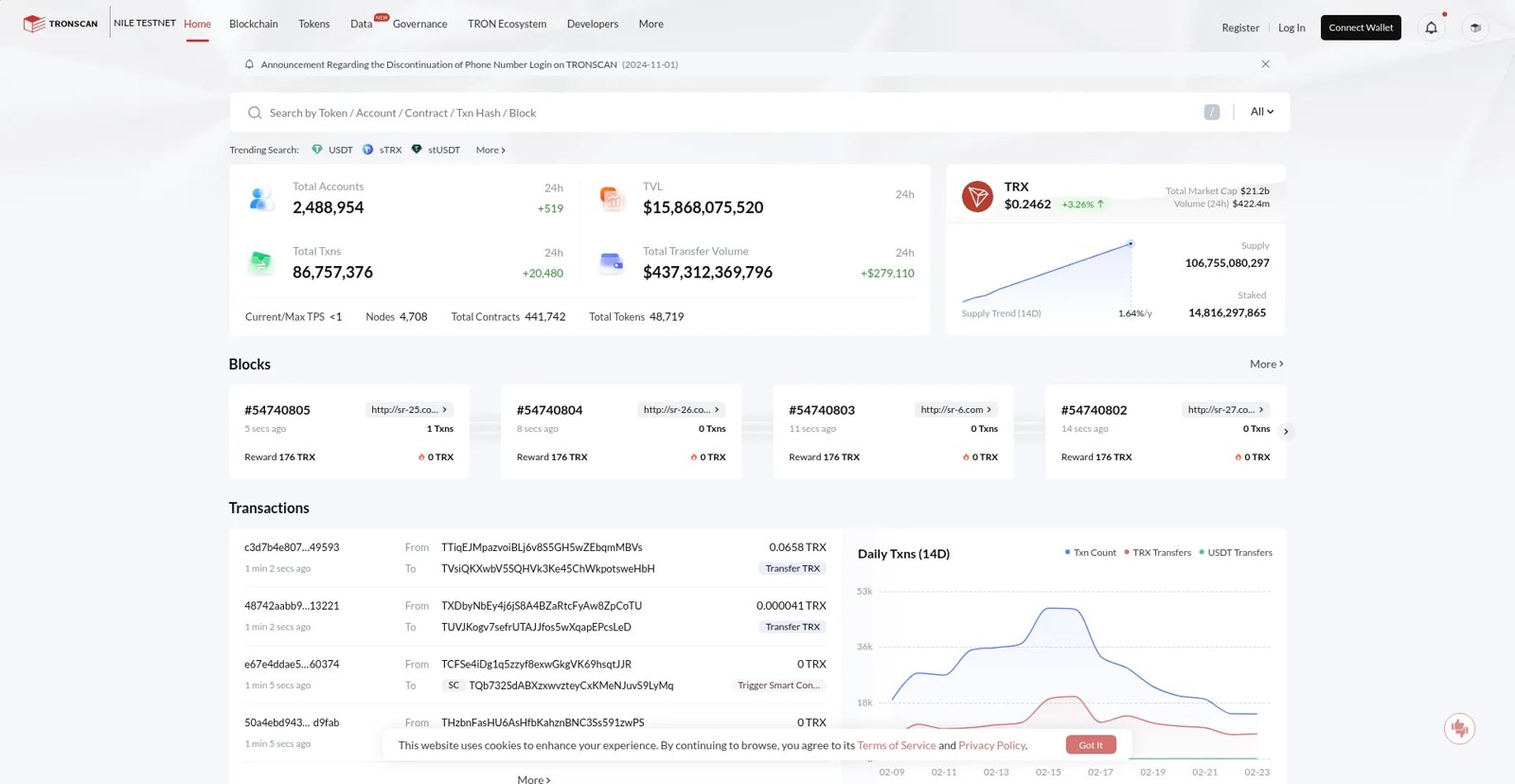
Tron scan is the search-and-browse layer people use to inspect activity on the TRON network: wallet balances, transaction hashes, TRC-20 token movements, smart contracts, blocks, nodes, and resource usage. Its strongest everyday use is making TRON activity readable, especially USDT transfers, TRX staking resources, Energy consumption, and fee estimates tied to bandwidth and contract execution.
The explorer matters because TRON handles a large amount of stablecoin movement, and the raw chain data is difficult to read without labels, token pages, filters, and resource calculators. A user pastes an address, transaction ID, contract, or token name into the search bar and gets a public record of what happened on-chain. The page does not move funds; it shows the evidence left by accounts, contracts, validators, and token transfers.
TRC-20 transfer records make stablecoin movement readable
TRC-20 is the token standard most users encounter through USDT on TRON. A transfer page shows the sender, receiver, token contract, amount, timestamp, confirmation status, and transaction hash. When a payment is delayed, disputed, or sent to the wrong address, this record becomes the shared reference point between wallets, exchanges, payment desks, and counterparties.
Tron scan displays token movement separately from native TRX movement, which matters when one transaction triggers a smart contract call rather than a simple coin transfer. The transaction detail view separates the contract interaction from the token event, so the visible USDT movement does not get lost inside execution data.
Energy and bandwidth explain why a TRON transaction costs what it costs
Day to day, TRON fees are built around resources. Bandwidth covers ordinary transaction data, while Energy covers smart contract execution. A plain TRX transfer uses bandwidth. A TRC-20 transfer, decentralized exchange trade, lending action, or contract approval uses Energy because a contract runs instructions on-chain.
The Resource Calculator and Energy-related tools help users estimate the TRX impact before interacting with a contract. Accounts with frozen or staked TRX receive resource allowances, while accounts without enough resources burn TRX to complete the same action. This is why two users sending the same token amount see different out-of-pocket costs: the token amount is separate from the resources consumed by the transaction.
Address pages connect balances, approvals, and counterparty history
An address page brings together the account's TRX balance, token holdings, transfers, contract activity, and resource state. It gives a practical timeline of what the account has received, sent, approved, voted on, or executed. Labels and token icons also reduce confusion when a wallet holds several assets with similar names.
Importantly, Tron scan is especially useful before trusting an address supplied in a chat, invoice, exchange withdrawal screen, or payment request. The account history shows whether the address is active, which tokens it has handled, and whether the latest transaction matches the amount and token expected. Public records cannot prove the identity of a person, but they do prove whether a specific on-chain event occurred.
Transaction hashes answer the status question fastest
A transaction hash is the cleanest way to resolve "did it send?" Paste the hash into the explorer and the result shows whether the transaction was confirmed, failed, or never found. A confirmed transfer includes block information, timestamp, participants, resources consumed, and any token event emitted by the contract.
Failed transactions deserve close reading because a user sees a wallet action but no token arrival. Common causes include insufficient Energy, contract execution failure, expired transaction data, or a target address problem. The visible reason varies by contract and wallet, yet the explorer record narrows the issue to an on-chain result instead of a guess.
Token Tracker and Hot Tokens help separate real assets from lookalikes
The Token Tracker groups TRC-10 and TRC-20 assets, supply data, holder distribution, transfer activity, and contract details. This matters on a chain where token names and tickers are easy to imitate. A familiar symbol alone is weak evidence; the contract address and token page are the stronger identifiers.
Hot Tokens and ranking views add market context by showing heavily viewed or active assets such as TRX, USDT, SUNDOG, PePe, PROS, and other visible ecosystem tokens. Tron scan gives the contract-level trail behind those names, including transfers and account distribution, rather than reducing a token to a logo and ticker.
Staking, voting, and Super Representatives appear beside transfer activity
In practice, TRON governance uses Super Representatives and voting power tied to TRX staking. The explorer includes governance pages for representatives, votes, parameters, and proposals, so account activity is not limited to payments. A wallet's resource position and voting behavior sit close to its transfer history because staking affects both network governance and transaction cost management.
When users stake TRX for resources, they change the economics of later contract calls. Enough Energy lowers the need to burn TRX during TRC-20 transfers or DeFi actions. Tron scan makes that relationship visible by placing account resources, transaction consumption, and staking information in the same public data environment.
Developer tools turn the explorer into a debugging surface
Builders use the explorer differently from casual senders. Contract verification, broadcast transaction tools, token encoding utilities, API access, TronWeb, TronBox, TronIDE, TronGrid, and testnet views for Nile and Shasta support application development and debugging. A failed contract call becomes easier to investigate when the transaction, emitted events, and contract address are visible in one place.
The API angle matters for wallets, payment processors, dashboards, and monitoring systems that need structured TRON data. API keys, indexed transfers, and account lookups let services pull explorer-grade information into their own interfaces. Tron scan therefore works both as a public website and as part of the data infrastructure around TRON applications.
A simple workflow for checking a TRON payment
Start with the transaction hash when you have it. Search the hash, confirm the status, match the token contract, compare the sender and receiver addresses, and check the timestamp. If the hash is unavailable, search the receiving address and filter the transfer list by token and time.
- Use the full address, not a shortened display string.
- Match USDT or another TRC-20 asset by contract address.
- Check whether the transaction succeeded before counting the payment.
- Review Energy and fee fields when a transfer cost looks high.
- Save the hash as the permanent reference for the event.
This workflow reduces the most common confusion around TRON transfers: a wallet notification is not the same as a confirmed on-chain event, and a token transfer is not the same as a native TRX transfer. The explorer record ties the visible wallet action to the chain's final state.
Where other tools fit around the explorer
Wallets such as TronLink focus on signing, balances, staking actions, and application access. TronGrid gives developers infrastructure for network data. DeFi interfaces such as JustLend DAO, SUN, SunPump, SunX, and JustStable create application-specific actions. The explorer sits beside those tools as the public ledger view that confirms what their transactions produced.
Block explorers on other networks serve similar verification roles, but TRON's resource model makes Energy and bandwidth unusually important to the user experience. Tron scan brings those costs into the same place as transfers, contracts, and governance, which is why it remains a practical starting point for understanding a TRON transaction after a wallet or app signs it.
Tron scan: questions and answers
What does Energy cost mean on a TRC-20 transfer record?
Energy cost is the smart-contract execution resource used by a TRC-20 transaction. A USDT transfer on TRON calls a token contract, so it consumes Energy in addition to any bandwidth used for transaction data. If the sending account has enough staked resources, the visible TRX burn is lower. If resources are short, TRX is burned to cover the execution cost.
Do I need TRX in the wallet to send USDT on TRON?
A wallet sending USDT on TRON needs a way to pay for the contract interaction. That payment comes from available Energy and bandwidth resources or from burning TRX when resources are insufficient. Holding only USDT leaves the wallet unable to cover the transaction cost unless another mechanism supplies the required resources for that transfer.
Which fields matter most when checking a token contract page?
The contract address matters first, followed by token standard, holders, transfer history, supply information, and verification details when available. Names and tickers are easy to imitate, so the contract address is the durable identifier. A legitimate-looking logo or familiar symbol carries far less weight than matching the exact contract used by the wallet, exchange, or application involved.
What happens if a TRC-20 transaction fails but TRX was charged?
A failed contract transaction still consumed network resources while the attempted execution ran. The token movement does not complete, but Energy or TRX used during execution is reflected in the transaction record. The detail page shows the failed status, involved contract, resource consumption, and available error information, which helps separate a failed token transfer from a delayed one.
Can an exchange deposit be tracked with only the receiving address?
Yes, the receiving address can be searched and filtered by token transfers, but the transaction hash is more precise. Exchanges also use internal crediting systems, so an on-chain arrival and an exchange account balance update are separate events. The explorer confirms that the TRC-20 transfer reached the deposit address; the exchange decides when to credit the user account.