Cryptocurrency guides
Tron scan is a TRON account search workflow for USDT transfers and Rent Energy decisions
Key takeaway: TRON blockchain explorer for searching accounts, transfers, contracts, and tokens, with built-in USDT tracking and Rent Energy tools.
Tron scan is a practical way to inspect TRON accounts, TRC-20 USDT movements, smart contract activity, token balances, and resource usage from one explorer interface. It is most useful when a user wants to search an address, confirm whether a transfer settled, read contract details, track TRX or USDT, and decide whether Energy resources should be rented before sending a contract-based transaction.
Account search starts with the address, not a wallet login
An address search opens the public record behind a TRON account: TRX balance, token holdings, transfer history, transactions, contract interactions, votes, and resource consumption. This matters because TRON activity is account-based at the explorer level even when the user arrives from TronLink, an exchange withdrawal page, or a copied transaction hash. The explorer reads the chain; it does not need custody of the account to display what already exists on-chain.
On Tron scan, the account page becomes the starting point for answering practical questions. A user sees whether an exchange withdrawal reached the right address, whether a USDT transfer used the TRC-20 token contract, whether the account has available Bandwidth or Energy, and whether recent activity matches the expected counterparty. That makes it a daily tool for reconciliation rather than a one-time lookup page.
USDT on TRON is tracked through token and contract records
USDT is one of the main reasons people search TRON accounts. TRC-20 USDT transfers are smart contract transactions, so the explorer needs to show both the transfer event and the transaction that produced it. The token page, account page, and transaction page work together: one shows the asset, one shows the holder activity, and one shows the execution details.
When a deposit is missing, the transaction hash is the cleanest clue. A confirmed transaction shows block information, sender and recipient addresses, token amount, timestamp, and execution status. If the transfer went to the wrong chain, the explorer will not magically recover it, but it clearly separates TRON activity from Ethereum, BNB Smart Chain, and other networks that also carry versions of USDT.
Rent Energy belongs in the fee check before a TRC-20 transfer
TRON transactions draw on network resources. Simple transfers use Bandwidth, while smart contract actions consume Energy. A TRC-20 USDT transfer calls a contract, so Energy matters. If the account lacks enough resources, the network charges TRX to cover execution. Rent Energy tools exist for users who want temporary Energy for contract activity instead of relying only on staked TRX or paying the full burn cost each time.
Day to day, Tron scan places Rent Energy near other practical tools such as the Resource Calculator, Broadcast Transaction, Sign & Verify, Contract Verification, and Multi-Chain Address Finder. That grouping is useful because resource planning is part of transaction execution. Someone sending USDT repeatedly checks the address, token contract, available resources, and expected cost before pushing the transaction from a wallet .
Transaction pages show whether the chain accepted the action
A transaction page answers the question that matters after pressing send: did the chain include it, and what happened during execution? Confirmed TRON transactions show their block position, hash, timestamp, result, contract call, resource consumption, and related token transfers. Failed or reverted activity leaves a record too, which helps distinguish a wallet display issue from an on-chain execution problem.
Importantly, Tron scan also exposes transfers and transactions as separate navigation paths because they serve different reading habits. A transfer view is asset-focused: who sent what to whom. A transaction view is execution-focused: which account signed, which contract ran, and which resources were consumed. Reading both views prevents confusion when a contract action creates more than one visible token movement.
Contracts, token tracker, and hot tokens add context around an address
An account does not exist in isolation. Token Tracker pages show supply, holders, transfers, and contract links for assets such as TRX, USDT, USDD, SUNDOG, PePe, PROS, and TBULL when those markets are active on TRON. Contract pages add verification status, code visibility, interaction records, and resource behavior. Together, those pages help users judge whether an address is interacting with a known token, a verified contract, or an unfamiliar deployment.
The hot-token and ranking views are not a substitute for due diligence, but they give context when an account suddenly receives a new asset or interacts with a trending contract. A token with visible holders, transfer history, and a contract record is easier to analyze than a symbol shown only inside a wallet interface.
Data charts turn individual lookups into network context
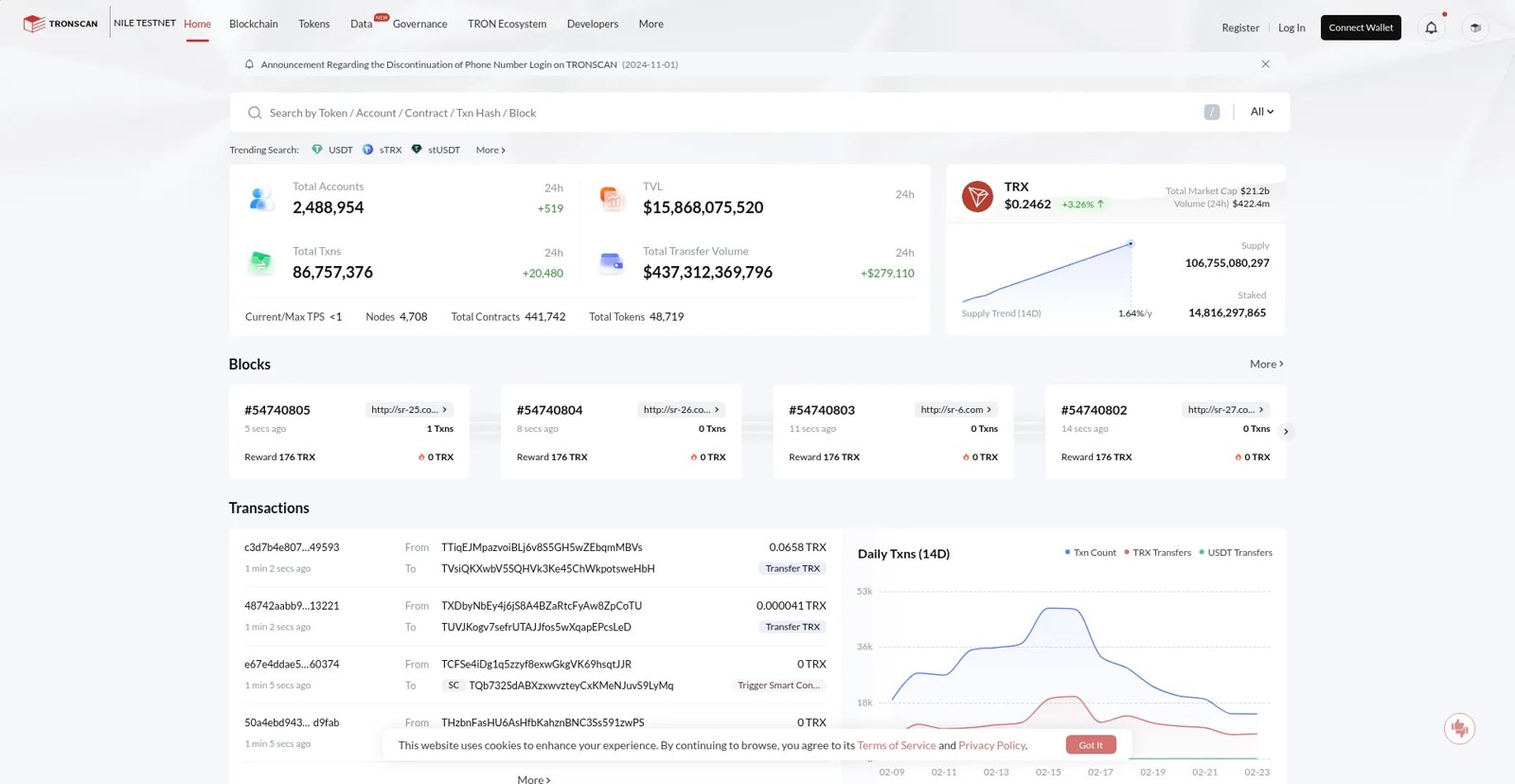
The explorer also publishes network-wide views: total accounts, active accounts, transaction trends, transfer volume, revenue, stablecoin dashboards, resource consumption, top accounts, top tokens, and top contracts. Those charts matter when a single transfer is part of a larger operating pattern, such as exchange settlement, stablecoin flow, DeFi activity, or contract-heavy usage during a busy period.
In practice, Tron scan is especially useful for stablecoin context because TRON carries large volumes of USDT activity. Seeing transfer volume and account activity beside individual transaction pages helps separate a local wallet question from broader network load. It also explains why resource planning is prominent on TRON: contract traffic, token transfers, and account activity all meet the same resource model.
Governance and staking records connect TRX to network operations
TRX is more than a transfer asset on TRON. Staking, votes, Super Representatives, parameters, and proposals are visible parts of network governance. Explorer pages for Super Representatives and votes let users inspect how accounts participate in block production governance, while staking-related views connect frozen or staked TRX to resources and voting power.
This is where account search becomes more than balance checking. A TRX holder can read whether an address has voted, where voting power is directed, and how resource choices affect the account. The same public-account model supports token transfers, DeFi interactions on products such as JustLend DAO or SUN, and governance participation without requiring separate explorers for every category.
Getting a clean read before sending USDT
A simple pre-send routine reduces avoidable errors. It keeps the user focused on chain, address, token standard, resources, and transaction result instead of relying on a wallet balance alone.
- Confirm the recipient address is a TRON address and not an Ethereum or BNB Smart Chain address.
- Check the token page or previous transfer history for TRC-20 USDT activity.
- Review available Bandwidth and Energy before a contract transaction.
- Use the Resource Calculator or Rent Energy path when repeated USDT transfers make resource cost important.
- After sending, search the transaction hash and compare the recipient, token amount, and execution status.
Notably, Tron scan fits this routine because it ties each step to public chain data. The wallet signs the transaction; the explorer confirms what the network recorded.
Where TronLink, TronGrid, and developer tools fit
Typically, TronLink is the wallet many users connect to the TRON ecosystem, while TronGrid, TronWeb, TronBox, TronIDE, Java-tron, and API services support builders and data products. The explorer sits between those groups: ordinary users read addresses and transfers, while developers inspect contracts, verify deployments, test on Nile or Shasta, and work with indexed network data.
In most cases, Tron scan should be read as an explorer and tool hub rather than a promise about any token or project shown inside it. Public visibility is valuable, but a visible contract, chart, or holder list does not make a transaction reversible or a token sound. The strongest use is evidence: hashes, blocks, addresses, contracts, transfers, resource usage, and governance records that match what the TRON network recorded.
Questions people ask about Tron scan
What fees should I expect when using Tron scan to plan a USDT transfer?
The explorer itself does not set the network fee for a transfer. TRC-20 USDT transactions consume Energy because they call a smart contract, and accounts also use Bandwidth for transaction data. If the sending account has enough staked or rented resources, less TRX is burned during execution. The Resource Calculator and Rent Energy tools help estimate the resource side before the wallet signs the transfer.
Does a confirmed TRC-20 USDT transfer mean the recipient wallet will show it immediately?
A confirmed transfer means the TRON network recorded the token movement to the recipient address. Wallet and exchange interfaces still need to index and display that event. If the transaction page shows success, the recipient address, and the correct USDT token contract, the on-chain part is complete. Exchange deposits also depend on the platform's internal crediting rules and required confirmations.
Which details prove I am looking at the correct USDT transaction?
The strongest details are the transaction hash, successful execution status, sender address, recipient address, TRC-20 USDT contract record, token amount, timestamp, and block confirmation. The transfer line should match the intended token and recipient, not just a similar ticker in a wallet. If those fields align, the explorer record is a reliable public reference for that specific TRON transfer.
Recovering access if an address was entered wrong on a TRON transfer
An explorer can show where the transaction went, but it cannot change the recipient after confirmation. If the destination address belongs to an exchange or service, the user must work through that service's recovery process. If the address is an external wallet controlled by someone else, only that controller can move the funds. The transaction page supplies the evidence needed for a support request.
Why do some account pages show tokens I never added to my wallet?
TRON accounts display token records based on-chain transfers, not on a personal watchlist alone. Anyone can send a token to a public address, so unfamiliar assets appear when contracts distribute or transfer them there. Treat the account page as a record of received token events, then inspect the token contract, holders, and transfer history before interacting with an unfamiliar asset.